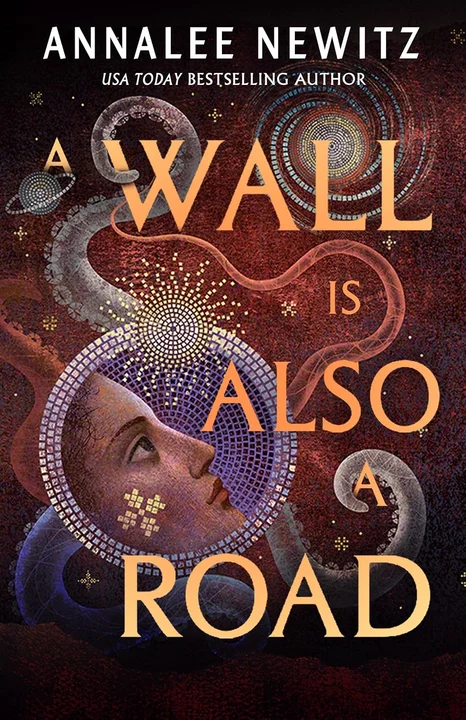
(Pub date 10/6/2026)
Science fiction is a genre that people have very decided feelings about. You either like it or you don't. And people who don't like it rarely get tempted to try it. I am a science fiction reader. The appeal for me is that it allows a writer to explore the same sort of concepts that are addressed in literary fiction, but by setting them in a wildly made-up context the issues can seem much clearer. Trekkies whose fandom is based on the Gene Roddenberry TV shows will understand this. Remember the episode with the two almost identical "races" of warring aliens who hated each other because one was black on the left side and white on the right while the other was white on the left and black on the right? The absurdity of racism based on skin color couldn't be clearer.
Author Annalee Newitz (they/them) is interested in both science and technology as well as science fiction. They have written seven books of nonfiction and five novels as well as countless short stories and articles for periodicals and newspapers. Newitz's books almost always surprise me but if there is an underlying theme that recurs in all their works it is the question of how we determine personhood and how we respect differences in our understanding of our fellow sentient beings.
"A Wall is Also a Road" juxtaposes ancient Pompei before the eruption of Mount Vesuvius and an advanced civilization of single cell life forms called The Rational People of the Globe on the periphery of the Milky Way galaxy. GardenPath has come to the Memory to earn not just a doctorate in science but to take a rare Fifth Exam to become an Investigator. Conventional wisdom is that there is no life on planets on the galactic plane, but GardenPath has found evidence that suggests there might be and wants to pursue it. The novel follows Gardenpath's life and relationships at school and also the relationship between Gardenpath and Murtis, a woman who is a courtesan in ancient Pompei. Gardenpath is a single cell organism much like an amoeba. The possibility of multicellular organisms existing is unheard of in the world of The Rational People of the Globe. Interestingly, the women that know Gardenpath's alien identity have much less trouble believing in alien life. Ironically, a rigid life of intellect which relies on scientific proof may limit a more expansive knowledge and understanding of the world.
Newitz seems to be making a comparison here between the way more primitive societies operate compared to "advanced" civilizations, or in other words, what our world has gained and lost as we have evolved. Life in ancient Pompei literally burns fast and furious. For all its hardships like disease and cruelty, life is lived with passion and imagination. Time even moves faster on Earth than on Gardenpath's world. Gardenpath aspires to a life of learning not doing. The role of Investigator is further study of your new discovery not field work. There is no disease in this world no hatred based on race or gender (which don't exist). Life is much more communal. But this isn't a utopia. Gardenpath has an abusive professor. There is an ongoing war between two planets and the sale of confidential scientific data to produce weapons.
I would categorize Newitz' fiction as cozy science fiction as opposed to space opera or hard science fiction. Their books are all stand alone and more focused on concepts than character development or plot. I am always curious about what Newitz will dream up next. If you are looking for something new and different, this author maybe one to check out.
reviewed by Jean C VanNoppen