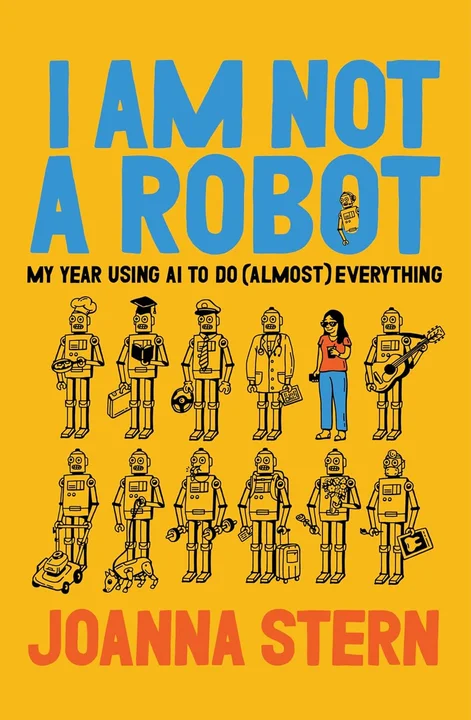
It’s the book about AI that you (almost) can’t put down. It’s written with flair, zip, expertise, simplicity, humor, and everyday examples. It’s about family, friends, employers, pets, and household dust. The book is Joanna Stern’s “I Am Not a Robot: My Year Using AI to Do (Almost) Everything.” It feels less like a book than somebody opened the front door and yelled, “Hey, you better come look at this. The toaster is thinking.”
The book is a diary of sorts by an ambitious writer insane enough to make a New Year's Resolution to, at the stroke of midnight on January 1, 2025, kick off what she calls her AI Year: 12 straight months of weaving artificial intelligence into every corner of her existence. “Not just when I was at work, writing emails, or doing research,” Stern said, “I’m talking 24-7, AI livin’.”
Stern is not some wild-eyed prophet standing on a hilltop screaming that artificial intelligence will save civilization. She is an Emmy Award-winning technology journalist. She spent 12 years at The Wall Street Journal, where her personal technology columns and video series made her one of the most influential voices in consumer tech. A two-time Gerald Loeb Award winner and Pulitzer Prize finalist, Stern often appears on national television, radio, and podcasts like The Vergecast. She lives in New Jersey with her wife, sons, dog, and more gadgets than a Best Buy (so said Stern).
So she knows what she’s talking about. She is comfortable making herself part of the experiment, which gives her writing a kind of “come along with me and watch this thing misbehave” quality. Stern comes at AI the way an average person might: curious, skeptical, amused, slightly alarmed, and willing to let the gadgets into her house just long enough to see whether they are brilliant, ridiculous, dangerous, useful, or all four. During the year she wore an AI recording bracelet (it logged 2,000 hours of audio), used AI to send over 5,000 messages, and wore Meta smart glasses that captured thousands of images. She piled her family into Waymo driverless cars for vacation trips.
Stern keeps the reader grounded in practical questions: Does this work? Is it useful? Is it creepy? Is it worth caring about? Publisher Harper Collins declares, “’I Am Not a Robot’ is one of the ‘clearest’ and ‘funniest’ pictures of the AI moment, which fits (Stern’s) style pretty well.” But underneath the jokes she is serious about trust, privacy, and the strange new bargain we are making with machines.
The premise is simple and wonderfully reckless. Stern spent a year letting artificial intelligence and AI-powered gadgets into nearly every corner of her life. Not just “write me a polite email to the insurance company” AI. She goes deeper into the machinery. Self-driving cars. Digital assistants. Chatbots. Health tools. Household robots. Career advice. Food planning. Education. Relationships.
What makes the book work is that Stern understands the central truth of this moment: AI is both amazing and dumb as a bag of rocks. The best parts are where technology collides with family life. AI, in theory, is one thing. AI around children, spouses, travel plans, meals, chores, and real human impatience is quite another. That is the fun of the book. Stern does not pretend the technology is useless. She lets AI help her, annoy her, entertain her, and occasionally expose how easily humans can be impressed by a machine that talks in complete sentences.
A natural question is did AI write Stern’s book? She asks your question for you in the introduction: “Did you just barf a year’s worth of notes and interview transcripts into an AI prompt, and then magically receive a completed manuscript on your doorstep in an Amazon box?” “Every sentence in this book started in my brain and traveled, via my MacBook keyboard, onto the page. AI never wrote anything from scratch, except in places that I’ve clearly marked.”
But underneath the jokes is a serious book about trust. That is the question running through the whole thing. How much do we trust these systems? And how much of ourselves are we willing to hand over because the machine is convenient and we are tired? That last part matters. AI is not spreading because everyone has suddenly become a futurist. It is spreading because people are overwhelmed, over-inboxed, over-scheduled, and sick of typing the same stupid email six times.
For readers who already follow AI closely, this book may not reveal every hidden chamber of the machine. For normal people who want to understand what this stuff feels like when it enters actual life, it is an excellent place to start.
reviewed by Allen VanNoppen