(Pub date 10/13/2026)
Bonnie Garmus' debut novel, "Lessons in Chemistry," was one of those delightful finds that people who frequent bookstores occasionally stumble across. I had never heard of either the author or the book, but I took the book home, sat down to read and rarely left the sofa until I had finished it. The characters were eccentric, the writing was funny in a quiet understated way and yet the writer had some deeper points to make about how we overlook people who are different, and in the late 1950s and early 1960s that included all women.
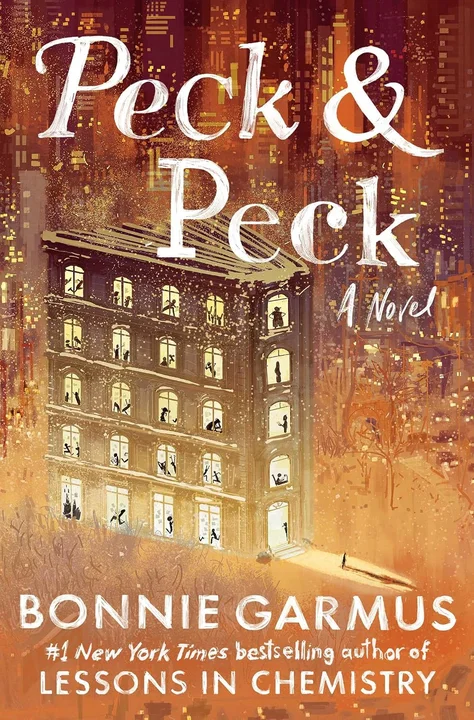
Garmus' second book, "Peck & Peck" has some of the quirkiness of her first book but a much less clear point. The story revolves around a young man named Batter, named for his mother's mythic dog, who falls in love with poetry at an early age. Batter's parents, especially his mother, a typeface designer, are very eccentric people and their parenting is not unlike that of Elizabeth Zott in "Lessons in Chemistry". Batter's parents and teachers try to get him interested in variety of careers but he is obsessed with poetry. The most influential poetry publication is the legendary monthly periodical, "Peck & Peck", founded and run by three generations of Peck twins. When Batter graduates from college he manages to get a job in the mailroom. No surprise, "Peck & Peck" is full of eccentric people and quirky traditions but it is being slowly destroyed by one of the twin brothers now in charge, a businessman who doesn't really like poetry. How Batter helps to return the publication to it's former glory and finds his place in the world is the heart of the novel.
"Peck & Peck" is filled with the recurring motif of twins. All the Pecks seem to have a twin. Batter has mourned his entire life for the death of his twin at birth. The poetry magazine was founded by Peck twin brothers who bought an unwanted piece of real estate in NYC saying it was just like poetry which "also no one wants". They hired 39 editors with a variety of specialties because they said they liked to argue, a point underlined by the one of the epigraphs for this novel, the dictionary definition for "peck" which includes the meaning to argue. The present day dysfunction at the magazine stems from the fact that it is being run by only one twin and he brooks no arguments with his sometimes arbitrary decisions. Garmus seems to be saying that we function best in dialogue with one another rather than as solitary actors. Batter achieves success at the end of the novel only by drawing on all his friends and family's help and moral support.
On one level, "Peck & Peck" is about finding and following your passion in life, becoming your best self. One of the editors at Peck and Peck says, "A calling. I've always wondered if I have one--or had one." And the response is, "Of course you have a calling. Be productive. Clean up after yourself. Make something. Love somebody...Don't become a doctor if you hate the sight of blood. Don't assume a high paying job means you are a success and a low paying job means you're not. Most important, don't aim low. And you know what's left? Things that with practice and sweat you could be really good at---maybe great at---maybe even the best in the world at. As for opportunities, if you're breathing, that is your opportunity."
You could be forgiven for assuming this is a novel written to extoll the beauty of poetry. There is actually very little poetry in "Peck & Peck". But poetry like all art forms is an example of man's attempt to create transcendental beauty. Some believe that the need to create separates man from other life forms. The final lines of the novel underline the importance of that creative urge, " [41 editors got to work] in a room filled with eggs, beneath a dome that demanded equality, in a building that refused to budge in pursuit and protection of three things. Originality. Beauty. Substance. It doesn't take a shadow box full of dodo eggs to teach us---anything less is extinction."
While this is not as tightly written a novel as "Lessons in Chemistry" and there are some plot points that don't make sense, Garmus has written another entertaining book.
reviewed by Jean C VanNoppen